Nature, the weather and plants have their own schedule--and they never check with humans when making it. A quick check of last year's garden journal last month revealed that this year's strawberry crop was coming a full three weeks early thanks to a spell of unseasonably warm weather and ample spring rain. The harvest was record-breaking: 83 quarts by the time I gave up and sacrifice the rest to the birds last week.
Unfortunately, the last of the peak picking days (14 quarts one day, 20 two days later) came just after I left for a week-long trip to Tennessee with my daughter. I processed 12 pints and 8 half pints of jam, along with 25 bags of frozen berries in the days before leaving. I arrived in Tennessee with a back sore from stooping and hands stained reddish-brown from hours of washing and hulling berries. When I returned, I added some fruit leather to my pantry, on the suggestion of a fellow gardener who makes real "rollups" for his kids. All in all, I 'm pleased with what I've stored up for the winter, and I had ample quarts to share with neighbors, friends and family.
I left my husband and son at home with the strawberries, but with school and work, they didn't have the couple of hours daily that it takes to pick the beds thoroughly. I invited a friend to come over to pick and take home all she could. I'm not sure my husband understood the innate urgency I feel when it comes to not wasting a single berry and to saving as much of the fruits of my labor as I can. The thought of my berries lying "mouldering" on the ground made me feel a bit sick.
The intensity of the strawberry season--and in turn, blueberries, blackberries, peaches and so on--reminds me yet again of the unforgiving cycle of farming. "Farmers must never go on vacation, except in winter," I moaned on my Facebook page as I packed for my trip. Then again, by winter they might be too tired to vacation. I recall the words of Anna Willson of Trumpington in Kent County, Maryland in the late 1800s. She struggled to entertain summer guests at the time of the peach harvest, after which her husband declared, "never again will we have staying guests during peach season." By the winter, with the preparations for the Christmas season following hog butchering, Anna was exhausted and decided against taking an excursion to Baltimore or even to attend holiday parties.
I also reflect on the situation of the local and migrant pickers, especially as my back aches and my knees groan after spending only a half hour or so stooped in picking. Although it may have been a relief to have a period of guaranteed work, the prospect of 12-plus-hour days spent bent over with forearms immersed in itchy strawberry vines must have tempered any enthusiasm. Historically, the abysmally low pay and substandard housing provided made life tremendously difficult for this under class of workers. But they, like me, were carried along on the tide of the season, working as hard and as long as necessary to get the job done. Then a break--often brief--until the next harvest wave arrived.
Wednesday, June 9, 2010
Friday, March 12, 2010
The Virtues of Vinegar

Several weeks ago, I bought 4 gallons of vinegar, earning me a strange look from the cashier at the grocery store. "That's a lot of vinegar," she commented simply. I couldn't quell the explanation--or rather excuse--inside of me. "There's a lot of uses for vinegar. You can make window cleaner and use it as a disinfectant and I even use it in place of fabric softener." I'd lost her. "Don't your clothes smell like vinegar?" I sighed. "No." Then I gave up. There were three people behind me in line, who I could tell silently groaned as I pulled out my reusable cloth grocery bags.
It's a good thing I didn't share my vinegar and baking soda/salt drain cleaner story. Near the end of week two of being essentially snowed in from the Great Blizzard of 2010, our toilet had started gurgling ominously. My daughter, well-known for her overuse of TP, already knew how to turn off the water at the back of the toilet just in time to stop the dreaded overflow. Now, she refused to flush at all, and the exclaims of disgust from the rest of us were a daily (sometimes twice!) occurrence. I looked out the front window where the vent to our septic tank lay uder 3 feet of snow. Even if we needed to, there was no way anyone could dig it up now. What to do?
We'd fought the battle of the clogged toilet before. Five or so years ago, we had a chronic blockage that would miraculously clear, only to come back again without any--uh--unusually large amount of flushable material going down the drain (or NOT going down the drain). My husband tried the metal snake, a truly frightening tool. I mean, what do you do with THAT after it's been used. I'd just as soon throw it away and buy a new one every time except I'm too cheap for that. Next, I surreptitiously went to the store and bought some awful, earth-killing drain cleaner which didn't help at all. Finally, we bought a new toilet. On a hunch, my husband decided to bust the old toilet open with a sledge hammer, an act which I'm sure was quite gratifying. Inside, he found a plastic ant trap, which acted like a flapper and had closed off the toilet drain when it got stuck.
We vowed never again to let things go so far, or to use ant traps on drafty bathroom windows. It was time for some drastic action. It was time...for vinegar. I discovered a simple recipe "to unclog drains" in a household hints book. Mix 1 cup salt with 1 cup baking soda. Pour it into the clogged drain and then add 1/2 cup white vinegar. Let it sit for 20 minutes. Then, pour 1 gallon of boiling water down the drain. My husband skeptically peered over my shoulder, worrying about cracked porcelain and melting pipes, as I pulled the handle. Everything went down. I was excited: "Let's do the other one too!" Thirty minutes later, all of our pipes were as clean as a whistle.
At that point, my son came in with an urgent look on his face. "Are you done in the bathroom? Ugh, what's that smell?" Flushed with success, I looked at him a little sheepishly. "Ummmm....boiled pee." He was horrified, but shooed us out anyway. Now if we can only convince our daughter that it's safe to flush.
Thursday, January 21, 2010
In the Bleak Midwinter

In the bleak mid-winter, frosty wind made moan,
Earth stood hard as iron, water like a stone.
Snow had fallen, snow on snow,
In the bleak mid-winter, long ago.
19th century hymn (one of my favorites)
As January draws to a close, Maryland is finally emerging from an early winter blizzard and deep freeze that had me doubting I would make it to the end of December with my sanity intact. Is winter this difficult for everyone? While I could force myself to go outside to exercise, to rake leaves, to do anything, the cold makes me want to stand with my back to the fireplace and "toast my buns," as I call it.
This is why my chickens have been a Godsend in so many ways. At least twice a day, I am forced to check on the status of their feed and water, and to look for eggs. Just before the December 19th blizzard, I discovered the push-in "nipples" on their waterers had frozen. The poor things may have been deprived of water for as long as three days--one of the down sides of my low-maintenance invention. I decided drastic measures were in order and put the red brooder lamp up in the coop. For nearly a week, I left it on almost around the clock. It may have been a cool 15 outside, but it was a spring-like 55 within the chicken inner sanctum.
The next shock for the flock was the 30-plus inches of snow. I trudged my way out to them midway through the blizzard and opened their door so they could get some fresh air. As usual, they noisily fought their way to be first out the door, until the first hen put her little toe into that icy white stuff and came to a screeching halt. Those behind her, especially the rooster, began complaining and looking over her shoulder to investigate the hold up. The result reminded me of their first trip outdoors as chicks: hens 1 through 3 and Randy the Rooster were ingloriously pushed out into the strange, white world by hens 5 through 10. The resulting commotion would have been rather funny if they were not so obviously traumatized. I left the door open during daylight hours after that, but I don't think they emerged until the snow began melting during the Christmas Day rain.
After exhausting my current file of recipes, including
Smoked Salmon and Cream Cheese frittata, Coffee flan, Cajun Spoonbread with Andouille, and Enchilada Strata, I decided I'd better try to get rid of a dozen or two here and there to friends and family. How fortuitous that one friend recently became a vegetarian! My mother-in-law is firmly convinced of the health benefits of home-grown eggs. And my Mom and brother have waxed nostalgic about the flock they used to have and will take as many eggs as I can spare whenever I see them. I charge a modest $2 a dozen and while I hate collecting money, I need to justify the costs of my rather expensive "hobby." So far, my hens have earned me $42.50. Of course, I still owe some of my customers about 10 dozen eggs, since they gave me cash to put on account, but that will buy about four 50 pound bags of feed. I am contemplating designs for a hand-painted sign that I can put out in the front yard on days when the refrigerator is overflowing with cartons.
So while the mid-winter blues keep trying to muscle their way in, my New Hampshires and Delawares keep me feeling like my little homestead is producing something. And hey, I still have lettuce in my hoophouse, carrots under a blanket of straw, and rosemary on the southern side of the house! In two more months, I'll be planting potatoes! The seed catalogs have arrived! Perhaps I'll make it through this bleak midwinter.
Monday, October 12, 2009
Fried Eggs, Frittatas and Flan
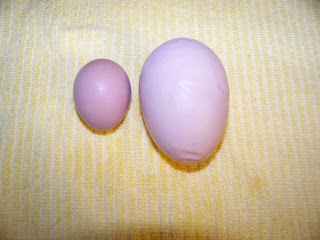
I've looked forward to lovely yellow yolks adding rich color to my baking. I've longed to make a quiche without worrying that I'd use up all my eggs before my next trip to the store. I never considered, however, what a challenge it would be to keep my stockpile of eggs down to under two dozen. Although our eggs are small--it takes about 4 of them to make the equivalent of 2 large eggs (about 1 cup cracked, useful information)--they are still piling up. The plan is to begin selling some of them to friends and neighbors to help offset the costs of my rather expensive hobby, but I figured I'd better wait until they were at least medium to large in grade (about 1.75 to 2 ounces each).
As a result, I've been looking for new ways to incorporate eggs into our daily meals. Early on, I made spoon bread using a favorite recipe from Colonial Williamsburg. This is a polenta-style cornbread made rich with the addition of four large eggs and served with generous amounts of butter. I've made several frittatas (think crustless quiche) in the last several weeks: ham and cheese, veggie, and still hoping to try the smoked salmon and cream cheese recipe I found. Oddly enough, Joe temporarily went on an egg-free diet, until I hounded him into having them for breakfast or lunch again. I've already added a book I found in Backyard Poultry to my amazon.com Christmas list: The Farmstead Egg Book.

My favorite dish so far has been flan, even though it was a bit of a failure. It has been a while since I made a caramel from scratch, and my first one turned into rock candy and the second into a pale, insipid syrup. A bit of hot water sloshed into the pie plate as I removed the custard from the hot water bath. Nevertheless, the flan was creamy, sweet and a beautiful shade of yellow. Who needs caramel? I must have eaten half of it by myself. Thinking perhaps crème brulée would be easier, I searched out some recipes and discovered they called for far more cream and yolks than I wanted to use (the whites always sit in the refrigerator and end up being tossed in the compost). On the other hand, the flan recipe using sweetened condensed milk and lowfat milk, which I decided to enrich with a bit of heavy cream, had just the right amount of richness I wanted without quite so much fat. Why not use the flan custard recipe in individual compote dishes, then broil the top à la crème brulée? After all, I have my own blow torch/flame weeder. And the best part of crème brulée is that crunchy, sugary topping that gives such great texture in combination with the smooth custard. So I have decided to try what may be a new dish: flan brulée!
Monday, September 14, 2009
Milestones in Chicken History

We are pleased to announce the arrival, at 1:45 p.m. on September 13, 2009, of our first egg. Collected by Joe Dolde, it weighed in at 1 3/8 oz, which would make it Grade TSFS--too small for sale. Each of us has since checked the nest about 5 times each, but egg number two has not arrived yet. It is pure speculation, but we believe one of the New Hampshires was the proud mama of Egg Number One, since shortly after its discovery we found her sprawled out in the yard nearly on her side, feet splayed out with seeming exhaustion.
Unfortunately, it would seem that Randy the Rooster was not so pleased with the theft of his potential future offspring. Poor Cleo opened the nesting box door to check for another treasure and he jumped out, neck ruffled intimidatingly, and flew up at her with spurs unsheathed. From the sound of her screams, I thought she had broken her hand under the heavy nesting box door. She was rightfully terrified, although I think Randy was just as frightened. We chased him in circles for about a half an hour and finally left the coop door open with the hens locked safely outside. Randy tried desperately to get back to his hens through the fence, then finally found his way into the coop and didn't protest when we closed the door quickly behind him. Now, whenever Cleo peers inside, he gives his best manly crow and flies at the door. I guess she's his arch-nemesis now.

Who knows why one hen picked this particular day to lay, but her timing was excellent. I had just arrived home exhausted from a camping trip. Joe went out to check for eggs about 1 p.m., and came back with his hands behind his back. "Guess what, Mom?" I felt a little invigorated, until he showed me his empty hand and I snapped at him in disappointment. Did one of the hens rise to the occasion to redeem her dear Joe, who feeds them tasty tomatoes and other treats? Or perhaps she got wind of my threat to cook one of them up if they didn't start laying soon. Do chickens read blogs? (*Thanks to Joe, who came up with the title for this post.)
Friday, September 11, 2009
My Rooster's Name is Randy

This September we are anxiously awaiting our first egg on the Dolde Chicken Farm. All my sources say that chickens are supposed to lay their first egg at 4 to 5 months. The laying hens will be 20 weeks old this Monday and by my calculations that is 5 months and I want to see results! A couple of weeks ago I switched them over to Purina "Layena" which has higher levels of calcium for laying hens. The hens appear to be fully mature; their combs and wattles have grown and reached a nice coloration.

In fact, the laying hens are huge, especially compared to my "broiler" hens in the moveable pen. At 14 weeks (6-7 weeks older than commercial broilers), I took a half a dozen hens to Locust Point Farm, where I buy my milk and where they raise and process their own chickens. I haven't given up on my desire/interest/determination to learn how to dress my own chickens, but in the heat of the summer without any sophisticated equipment the prospect of splattering myself in blood and boiling feathers was not attractive. The Amish family at Locust Point dressed my birds for $2.60 each and vacuum sealed them in a lovely wrapper that said "Dolde - Pastured Chicken." I almost leapt for joy.

So one Sunday (Monday is butchering day), I placed the borrowed dog cage next to the moveable pen, asked my husband to act as doorman, and tried to catch some birds. Of course I didn't want to CLIMB inside; anywhere chickens live is poopy and the pen is only 24 inches high. Eventually, though I had to lean inside and grab them with my gloved hand. This is not a job for the timid. You go for the feet and bring them out upside down while they squawk like you are murdering them. It seems rather cruel until I right them, gently fold down their feathers and hold them in both hands for a second. Within seconds they calm down and settle into a purr-like clucking. Then it was into the dog cage quickly and back to find one of her sisters.
My daughter rode with me to the farm and anxiously peered back at the excited chickens in the back of the open truck, their feathers flying. "I don't think I can eat them," she worried. "You'll be fine," I assured her. I was surprised to see a whole row of cat cages, milk crates and chicken coops when I arrive at the farm. Apparently I'm not the only one experimenting with my own free-range chickens. They asked if I wanted my birds whole (yes) and if I wanted to keep the giblets (no). They would process them that morning, chill them down and they would be ready for pickup on Thursday. When I returned, the Amish girl looked apologetic. "They looked as big as ours," she said, "but I guess they just have longer legs. They are a little small." My biggest hen topped out at 2 1/2 pounds. No matter, this was an experiment and I'll just have to keep the rest of them a little longer.
We had chicken for dinner that night and everyone ate it with no trouble. We opted for butterflying the small bird and grilling it with barbecue seasoning. It was pretty tasty, and probably the best method of cooking we've found so far. I cooked another in an infrared oven someone gave me (cooks without giving off heat), and another one in the crock pot--it was 100 degrees in my kitchen most of August so I didn't relish turning on the oven and was looking for other methods. Both of those were disappointing. All in all, I am still reserving judgment. The hens are small--one barely feeds my family of four and two of us have small appetites--and I did find the texture a little stringy, but perhaps that was the cooking methods.
I am anxious to see how heavy the final six will be and how they taste. But I swear they have gone on a hunger strike. They seem to be two-thirds the size of the laying hens and although I purposely tried to pick the smallest birds when I separated them at 8 weeks, I don't think I was that successful. They just don't seem to be growing as fast. You'd think they would be happier with fresh grass every other day. Maybe it's the low roof or the exposure to the occasional thunderstorm. Perhaps I'm overthinking this whole thing? In any case, we will see what the next few weeks bring and I'll decide whether to try Delaware broilers again or switch to a faster-growing Cornish cross. I really want to experiment with brooding my own chicks at least once.
But if those hens don't start laying, I just might grab one of them and see how she cooks up. Or it just may be the rooster, if he doesn't stop crowing at 5:30 a.m. and tormenting the hens. Yes, our rooster friend Randy has found his mojo. Over the last month, I have run excitedly out to the coop several times when I heard what sounded like productive squawking, only to find Randy cornering some poor hen in the corner. Gone are the days when they would chase him away from a tasty lettuce leaf or tomato. So far, he has not inflicted any damage and he is acting naturally after all, but I can't help but regard him with a little disgust when he struts off after terrorizing half the flock. Roosters have their place, I suppose, as we learned when my sister-in-law's dog took a polite peek at them last weekend. Randy sounded a cry of alarm so terrifying that poor Rio jumped back and would have run away if he wasn't on a leash. So we'll let Randy rule the roost--for now.
Sunday, July 12, 2009
Hangin' With My Peeps
Tomorrow my chickens will be 11 weeks old. They now look like full-grown chickens and talk like them too. I'm not sure when that happened; it seemed they peeped like chicks until very recently. The rooster's comb and wattle are now in full coloration, and the other day we saw him, well, trying out his moves. This morning, my husband heard something he thought was an attempt at crowing, but more like "aaarrgheew." Perhaps we have a pirate rooster.
About a month ago, I divided half of the chickens off into a mobile pen inspired by the design from Joel Salatin's book Pastured Poultry Profits. We made a few design changes of our own. The roofing is a nice barn red made from Ondura, an EPA environmentally-preferred product made from 50% post-consumer content (tires, we think). We attached some large lawn mower wheels that slip on and off of carriage bolts, and pick up the other end with a (too) small handle to move the pen to fresh grass.
The chicken tractor, however, has made it apparent that my chickens are pigs. Unable to control their desire to roost on everything, they sit on the feeder and the waterer and poop in everything they consume. Even though articles I read said don't give broilers roosts because they will develop unattractive breast blisters (huh?), I put in a 4-foot 2x2 as a roost, covered the feed with a piece of plywood and the waterer with a chicken wire cone. Somehow, they still manage to poop in the water. I have plans to create a waterer using the push in nipples that commercial growers use in lines of pvc pipe. I read about it in Backyard Poultry, but instead of buying the kit, I think I will just buy the nipples and screw them into the bottom of plastic kitty litter buckets. Fresh water goes in the top, lid goes on, waterer is hung and the chickens have to reach up to peck a clean drop of water from the bottom of the bucket. Ahhh, poop-free beverage. Part of this comes from my natural repulsion to any living thing drinking contaminated water; part of it from my desire NOT to have to treat my chickens with antibiotics because they become sick.
You may ask how I selected which chicks to remove from the flock for certain death. Initially, the plan was to pick the birds that did not appear to be as strong or that had the poorest coloration in their feathers. In reality, as my husband closed me into the coop to catch them and they all ran for a corner, it became which ones were slowest or thrown in front of my waiting hands by their comrades. In the end, I selected 7 Delawares (the white ones) and 5 New Hampshires (the red ones) because while I want to know which tastes best and/or grows the fastest, I think the New Hampshires are prettier and thus want them to live. I'm not entirely comfortable about what that says about me.
Commercially-grown birds are usually slaughtered at about 7 weeks. Sometimes they grow so fast and so breast-y that they can hardly hold themselves up on their scrawny chicken legs. Even though I will have a poor "feed to pound ratio"--meaning the cost of how much feed I am giving them versus how many pounds my dressed broilers will weigh--I have decided to keep my birds longer. Some only have a week left. Others I may keep to 14 weeks. That's twice the life they would have had, and with fresh grass daily along with treats of lettuce from the garden. We may feel sad to see them go, but they had a much better life than the chickens in the grocery store.
Subscribe to:
Posts (Atom)

